Handheld laser welders are everywhere, but most buyers only learn the tradeoffs after a bad quote or a weak demo. You may be wondering what “portable” really buys you, which specs are marketing noise, and what hidden costs show up in the first month of ownership.
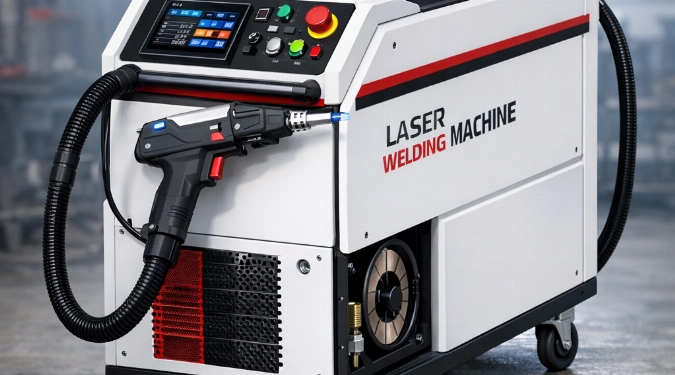
Know when a portable laser welder beats TIG or MIG. Learn the specs that matter, the real costs, and what consumables you will actually burn through. You will leave with a buying checklist, brand short list, and test weld steps to run before money changes hands today.
What “Portable” Really Means In Laser Welding
Portable units are usually handheld fiber laser systems. The “gun” is light, but the power source is not pocket sized. Expect a wheeled cabinet or small cart package. Typical input power is single phase $220V. Some models accept $110V at reduced output.
Portability changes workflow more than it changes physics. You bring the torch to the part, not the part to a bench. That matters for gates, railings, tank repairs, and trailer work. It also matters for shops with limited floor space.
The Specs That Actually Change Your Weld
Ignore marketing terms like “super weld.” Focus on these numbers.
Wattage And Duty Cycle
Most portable welders land at $1,000W to $2,000W. $1,500W is the common sweet spot for mixed work. Duty cycle tells you how long it can run before cooling. Ask for a duty cycle chart at max output.
Beam Quality And Spot Size
Beam quality affects penetration and bead shape. Small spot sizes concentrate heat and boost speed. Ask for spot size ranges and any collimation specs. If they cannot explain it, move on.
Wobble And Modes
“Wobble” oscillates the beam to widen the seam. It helps bridge small gaps and smooths the bead. Look for adjustable wobble width and frequency. Also check for preset modes for corner, lap, and butt joints.
Wire Feeding And Gas
Many handheld systems can run autogenous welds. Real fabrication often needs wire. Confirm it supports a synchronized wire feeder. For shielding gas, most users run argon. Some applications use nitrogen on stainless.
Why Portable Laser Feels Different Than TIG
The heat affected zone is smaller. Distortion is often lower on thin sheet. Post grind time can drop on cosmetic seams. Learning curve can be shorter than TIG for simple joints. Fit-up still matters, especially for gap control.
Laser welding dislikes dirty material. Mill scale, oil, and paint cause porosity and spatter. Plan on cleaning with a flap disc and solvent wipe. Keep fume extraction close to the plume.
Real Price Ranges And What Drives Them
Portable units vary by source quality, chiller design, and support. For a new $1,500W handheld fiber system, expect about $7,500 to $16,000. $2,000W packages often sit around $11,000 to $22,000. Air-cooled systems can cost less, but can limit run time.
Consumables are not zero. Plan for $50 to $250 per month for tips, nozzles, protective windows, and lenses, depending on use. Budget for a real fume extractor. Entry units start around $900. Stronger shop units run $2,500 to $6,000.
If you are comparing shop equipment, remember the Price Of A Laser Cutting Machine For Steel In US is a different budget class. Cutting systems can jump from $60,000 to $300,000+.
Six Brands Worth Comparing Before You Commit
These names come up often in real shops and distributor catalogs.
- IPG Photonics
- TRUMPF
- Amada Weld Tech
- LaserStar Technologies
- Coherent
- Han’s Laser
Ask each seller for a sample weld video on your material. Better, request a live demo with your parts.
A Fast Demo Checklist You Can Use
Bring three coupons of each material you weld most.
- 16 ga mild steel with mill scale left on one coupon
- 304 stainless, brushed finish
- 6061 aluminum, clean and oxide-scrubbed
During the demo, check start consistency, bead width control, and corner handling. Do a bend test in a vise. Look for cracking along the weld toe. Ask to swap operators mid demo. That reveals how forgiving the setup is.
Where Portable Lasers Fit In A Real Shop Mix
They shine for short runs and mixed materials. They are strong for cosmetic stainless, HVAC duct seams, and thin enclosures. They are also useful for rework and repair where clamping is awkward.
They do not replace heavy plate processes. For thick structural joints, you may still prefer MIG or submerged arc. For code work, confirm procedure and documentation needs.
Buying Notes For Local Shops And Crews
If you are trying to Buy Laser Machine In US, focus on service coverage and parts lead times. If you are comparing Laser Welding Machine Price In FL, request an itemized quote. It should list source, chiller, gun length, wire feeder, and training.
Some buyers search Laser Machine Kopen In miami after seeing imported units online. Treat it like any capital tool. Ask for serial numbers, warranty terms, and a local repair path.
For Metal Fabricators In FL, portability can reduce handling damage on finished assemblies. For crews shopping Metal Working Machines In FL, confirm your electrical panel and air supply first.
References
- American Welding Society (AWS) publications and safety resources
- OSHA guidance on laser hazards and ventilation basics
- Manufacturer datasheets for handheld fiber laser welding systems
Disclaimer: The information provided in this article is for educational and informational purposes only. It does not constitute professional advice. Readers should conduct their own research and consult with qualified professionals before making any decisions.
Leave a Reply